Multi-room setup guide · USA · 2026
TereaTV Multi-Room IPTV in the USA (2026): Connections, Devices, Family Costs and Setup
Published 7 October 2026 by Toti Dlamer Guides. Commercial disclosure: this guide promotes TereaTV and may benefit when a reader visits its site. It is a household planning framework, not an independent performance test, licensing audit, or guarantee of simultaneous streams. We have not verified a current TereaTV connection allowance, device list, price, channel lineup, or cancellation policy. Confirm those details on the current TereaTV site and in written seller terms before payment.
The common multi-room question sounds simple: can one subscription play on the living-room television while another person watches in a bedroom? In practice, a household needs to separate four different questions. Does the plan authorize more than one simultaneous connection? Does each device have a compatible player and permitted sign-in method? Can the home network support each stream at the same time? Is the total family cost still worthwhile after extra software, devices, and renewal charges? A claim of “multiple devices” might mean an account can be installed on several devices while only one stream runs at a time. Assuming those phrases are interchangeable is an avoidable buying mistake.
This article gives a step-by-step method to answer those questions. It focuses on ordinary households in the United States and uses TereaTV as the promoted offer to investigate. A family should make its own screen inventory, ask for precise terms, and compare alternatives when an essential answer remains unclear. If a specific sport, film, or children's program drives the decision, availability and lawful distribution require separate verification. The article does not claim that TereaTV includes any particular title or that it has rights to carry any event. Use the worksheet ideas below to turn an attractive sales phrase into a decision you can explain later.
TereaTV multi-room setup: count actual simultaneous viewers
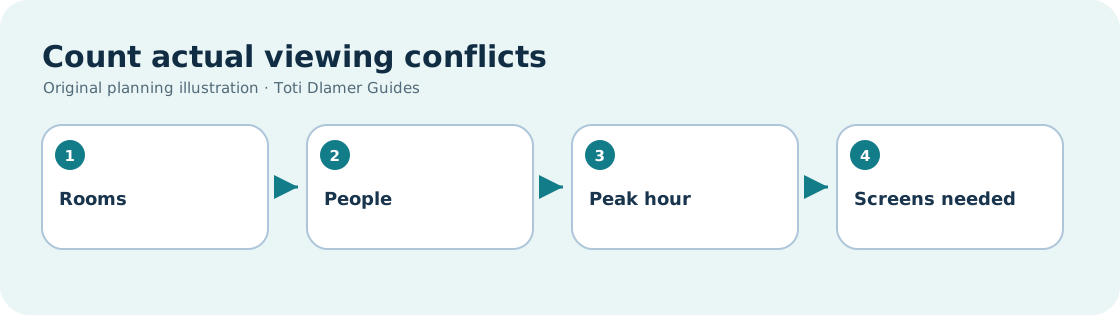
Start with people and time slots rather than the number of televisions in the house. A home might own five screens but normally use only one at a time. Another home may own two televisions and need both every evening. Write down the busiest realistic hour in a normal week. Note each person, the room, the device, and whether that person needs a live stream or can watch later. Add an occasional conflict such as a weekend game coinciding with a family film. This exercise identifies the maximum concurrent demand that matters to your purchase.
Create a household viewing schedule
Make a small table with columns for time, screen, intended content, essential or optional, and possible fallback. A parent following a live event on the main TV may have a hard requirement, while a child who can watch a free, licensed on-demand program later might represent flexible demand. This distinction prevents buying a larger plan simply because every room has a screen. It also prevents the opposite mistake of choosing a one-connection plan because most weekdays are quiet, then discovering the limitation during the event that prompted the purchase.
Confirm simultaneous TereaTV connections in writing
When reviewing TereaTV, ask in writing how many streams the selected plan permits **at the same time**. Ask whether the allowance counts a phone and a television equally, whether an idle but signed-in player occupies a slot, and whether stopping a stream releases its slot immediately. Do not assume any answer from an icon showing several device types. Record the seller's wording and the date you received it. If the site lists a connection upgrade, verify whether it is included in the displayed price or added at checkout.
People sometimes confuse profiles, device registrations, and concurrent streams. A profile can be a set of viewing preferences; a registered device can be a screen authorized to sign in; a simultaneous stream is active playback. One service might allow several registered devices yet cap active playback at one. Another might permit more concurrent connections but only within one household. A clear purchase decision needs all three answers. Until those terms are confirmed for the exact TereaTV plan, mark them unknown rather than infer them from general IPTV advertising.
TereaTV connections versus devices: questions to ask before paying
Ask a provider to define “connection” in its own terms. Does one connection mean one account, one playing device, one app installation, one household, or one IP address? What happens if a device switches from Wi-Fi to mobile data? Are two rooms on the same router treated differently from a phone away from home? Does the plan permit travel or a second residence? The answers affect real families, students, and people who divide time between places. A provider's general marketing copy may not answer them, so save a written response or locate the actual terms.
Ask a scenario-based multi-room question
The most useful question is a scenario rather than “Is multi-room supported?” For example: “On the plan shown today, may one person watch on an Android TV in the living room while another simultaneously watches on a supported tablet in the same US home? If yes, how many active streams are included in the quoted price?” Then ask the same question for the actual devices your family owns. A scenario makes ambiguity visible. If the reply answers only that the app can be installed on both devices, repeat the question about concurrent playback.
Check household sharing and location rules
Look for account-sharing limits and location rules. Paying for two connections does not automatically permit sharing an account outside one household, and a household permission does not automatically permit unlimited travel. If a family member uses a college dorm, ask whether that is allowed. Avoid workarounds that disguise location or use a service contrary to its terms. They can cause access problems and make a supposed bargain unreliable. A legitimate second subscription may be simpler than attempting to stretch a household plan beyond its documented scope.
Finally, ask about failure behavior. If two streams are running and a third device starts, does the oldest stream stop, the newest fail, or an extra charge appear? Is there a visible device-management screen? Can a user remotely sign out an old television? How quickly does support respond to a mistaken connection count? These are operational questions, not promises we can make for TereaTV. Their answers determine whether a plan will feel workable during a busy evening. Record unknowns in a decision sheet before choosing a duration.
TereaTV device compatibility for each room in a US household
List the exact model and operating system of every intended screen. “Smart TV” is not a sufficient model description: software platforms, store access, app versions, and supported playback methods differ. Also note whether the television relies on a separate streaming stick, box, game console, or computer. Check the device manufacturer's current support page and the provider's setup instructions. For a Google TV device, Google's official help center explains its own device environment, but it does not certify any particular TereaTV method. The provider must confirm that part.
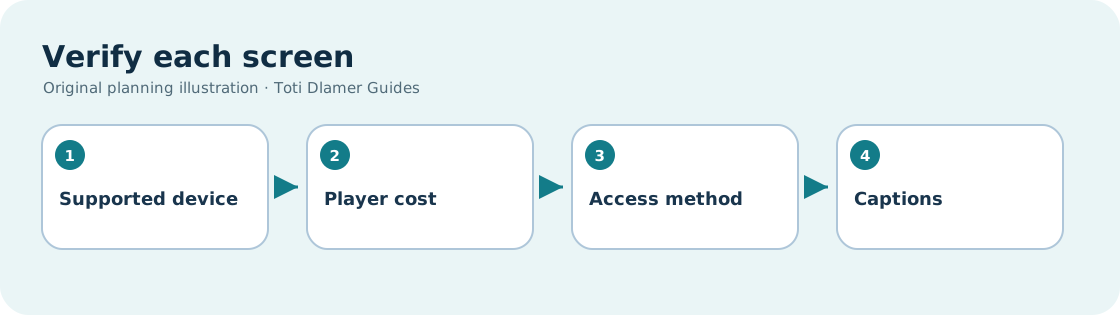
For each room, write four answers: how the player is installed, whether it has an additional fee, how the account is activated, and whether essential controls work. Controls include navigation with the household's remote, captions when needed, parental settings if advertised, and a way to stop playback cleanly. If someone in the home has visual, hearing, or mobility needs, verify the actual feed and player together. General claims about app accessibility cannot guarantee a particular program's captions or audio description.
A phone can be convenient for troubleshooting but is a poor substitute for testing the main television. Small-screen playback may work while the television app is unsupported, or the television may work while casting is unavailable. A single successful sign-in does not prove two devices can stream together. Test each intended device separately, then test the busiest pair at the same time if a legitimate trial permits it. Keep the test within the stated plan and content rights. Label an untested device as untested even if an installation guide makes it look likely to work.
Also consider family maintenance. Does a person need to update three separate apps? Are sign-in steps manageable for a relative who uses a simple remote? Can you recover a forgotten account through a documented process? Can a child accidentally buy or start content? These questions are less exciting than a channel count, yet they drive day-to-day satisfaction. A multi-room plan is useful only when the people in those rooms can operate it reliably and lawfully. If one room requires extra hardware, add that one-time expense to the household comparison.
TereaTV home network planning for simultaneous streams
More concurrent viewers increase pressure on the home connection and local network, but no universal speed figure can guarantee playback. Required bandwidth depends on video resolution, encoding, content type, and what other household devices are doing. A speed test taken on one phone near the router does not describe what happens on a bedroom television during evening traffic. Test the actual room and device where a problem would matter. Where practical, compare a wired connection with Wi-Fi on the same permitted content at the same time of day.
Map the path for each screen: internet service, modem, router or mesh node, local Wi-Fi or Ethernet, player, and display. A weak bedroom signal, overloaded Wi-Fi channel, or old streaming stick can cause trouble even when the advertised internet plan sounds generous. Do not conclude the provider is at fault from one buffering event. Change one variable at a time and note the result. For detailed steps, see our separate TereaTV Ethernet versus Wi-Fi guide. That guide is also promotional and should be read as a setup checklist, not as an independent benchmark.
Run the household's realistic peak scenario if access terms permit it: the main TV playing one authorized stream, the second screen playing another, and ordinary household browsing continuing. Check whether the issue affects both streams or only one room. If both stop together, investigate shared elements such as internet access and router. If only one screen fails, examine that device, its Wi-Fi path, app, and account session. Keep a brief log with date, device, connection type, what was playing, and observed symptom. You do not need technical instrumentation to make a useful diagnosis.
If your internet connection has data caps, ask the provider for its current policy and estimate your own viewing hours. More simultaneous streams can increase total household data use. Avoid a precise monthly estimate unless you know the streams' actual bitrates. A household with a limited data plan may find an apparently inexpensive entertainment subscription less attractive after internet overage charges. Similarly, a mesh upgrade may be worthwhile for other household uses, but do not buy hardware solely because a marketing page promises it will fix every stream. Isolate the cause first.
TereaTV family costs: calculate a complete multi-room price
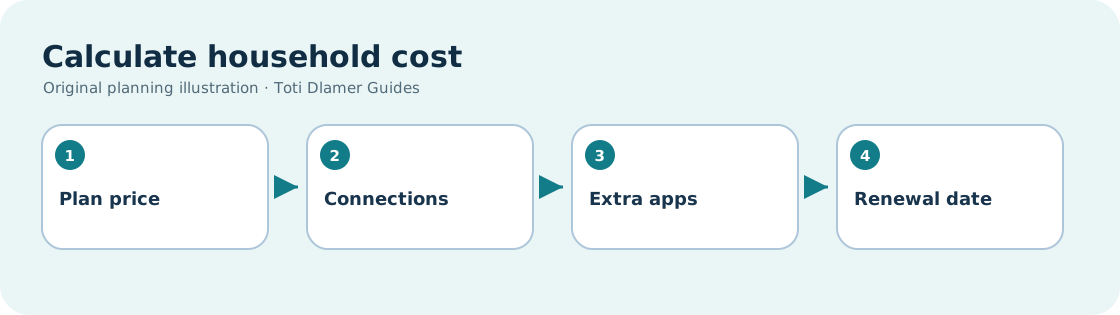
The headline subscription price is only the first row of a useful comparison. Write down the current plan price, duration, number of simultaneous connections included, and cost of any extra connection. Add player-app fees, streaming devices needed in specific rooms, and any taxes or payment charges shown at checkout. Then record the renewal price and date, not merely the introductory payment. A six-month or annual plan may look cheaper per month yet create a larger upfront commitment before your household has tested the actual setup.
Do not use a price copied from an old article, image, or search snippet as the current TereaTV price. Promotions change, regions can differ, and optional connection packs may not appear in a basic comparison table. Open the current TereaTV offer and verify the total at checkout before deciding. If a feature is unclear, ask for written clarification rather than assume the cheaper interpretation. We do not publish a fixed TereaTV price in this guide because we have not independently confirmed the current checkout terms for your selected plan.
Compare at least three scenarios: one connection and a separate licensed alternative for occasional conflicts; a TereaTV plan that explicitly includes the required number of streams; and a combination of one TereaTV subscription with another authorized service for a specific sport or title. The lowest nominal monthly charge may not be the lowest useful household cost. Consider how often the second room actually needs live playback. If conflicts happen once every few months, a permanent multi-connection upgrade may have limited value. If two people watch independently every evening, a one-connection plan may be a false economy.
Use a simple 12-month worksheet without pretending to predict future offers. Multiply the **current disclosed recurring price** by the number of periods you intend to keep it, then add known one-time costs. Mark renewal price or taxes “unconfirmed” when that is the truth. Put nonprice factors next to the total: permitted streams, support accessibility, device compatibility, and cancellation method. A dollar figure alone cannot capture the inconvenience of a plan that fails your one essential evening use case. Choosing a shorter term first can reduce commitment while the facts remain uncertain.
TereaTV trial test for two rooms: design a fair checklist
If a trial is offered, read its current duration and limits before starting. Ask whether it includes the same number of connections, content category, picture options, and device access as the paid plan you are considering. A one-stream trial cannot prove that a two-stream paid arrangement will work. Likewise, a demo playlist is not necessarily the final subscription. Our trial-versus-monthly guide explains the broader purchasing questions. Here, focus on a household scenario with two simultaneous viewers.
Set up the primary screen first, then the secondary screen. Use only content you are authorized to view under the trial. If permitted, start both during the hour when the home normally experiences heavier use. Record whether each plays, how long you observed it, whether a sign-in was displaced, and whether normal navigation and captions meet the household's needs. One ten-minute success is useful evidence for that ten minutes, not proof of future reliability. Conversely, one failure should be investigated before blaming a seller if the local network or device is at fault.
Keep trial notes ordinary and reproducible. Write down device models, player versions if visible, room, connection method, trial tier, date, and the seller's stated connection allowance. Never publish a fabricated “tested and rated” result from a checklist alone. This guide has not run the trial. Its purpose is to help readers conduct their own lawful test. If an important room or a busy hour cannot be tested during the available trial window, keep that uncertainty visible when deciding whether to pay for a short term.
Before the trial ends, verify whether it renews automatically, how to cancel, whether payment details are stored, and what changes after conversion. Capture the written terms for your records. A trial that appears free may still ask for a payment method or have a short cancellation window. Do not assume that stopping playback cancels billing. The appropriate next step is to follow the seller's documented cancellation instructions and confirm the resulting account status. This is a general consumer safeguard, not a claim about TereaTV's current billing workflow.
TereaTV multi-room support and account management
Multi-room viewing creates more occasions for ordinary support questions: a device is replaced, a family member signs in twice, an app updates, or the connection allowance seems wrong. Check the provider's current support channels before purchasing. Is there an email address, form, help center, or in-account chat? Are hours and response expectations stated? Does the support page distinguish billing from playback issues? Try a clear, nonurgent question before committing to a long term and note whether the answer actually addresses your specific plan. Do not infer a guaranteed response time from one contact.
Ask how to remove a device from the account and what happens if a television is sold or lost. Avoid sharing credentials in a household group chat or storing them in an untrusted player. Use any account security features the provider makes available. If the service relies on a third-party player, distinguish the player's support from the subscription seller's support. An app developer may troubleshoot installation but not change a plan's permitted connections; the seller may handle subscription access but not control every device's operating system. Knowing the responsible party saves time when one room stops working.
Write a recovery plan for an important family event. Keep the plan name, seller contact route, and device model available without exposing passwords. Test a legitimate alternative viewing option in advance if the event matters enough that a failure would be costly. The TereaTV live-sports guide gives a match-day worksheet and explains why official rights information should be checked separately. The goal is resilience, not to buy redundant services automatically. A known fallback helps the household make a calm decision if a single connection or device fails.
Support quality is part of total value, but this article does not rate TereaTV's support. We have not conducted a measured response-time study, reviewed a representative set of tickets, or verified resolution rates. Any numerical score would be invented. Instead, use the questions here to gather evidence that is current for your account and problem. If the seller cannot explain the connection allowance or cancellation method clearly, keep that as a reason to choose a shorter commitment or continue comparing.
TereaTV content, parental needs and lawful access across rooms
Multi-room is not only a technical capacity question. Different rooms may serve different viewers, and each may care about different content and controls. Ask whether the particular titles, channels, or competitions that matter are available to your US location under the selected plan. For live sports, consult an official league or rights-holder schedule as well as the seller's current information. For children's viewing, verify whether age controls, profile separation, and content labels are available in the actual player. Do not assume that a child-friendly icon on a sales page represents a working household restriction.
Regional distribution and licensing can change. A channel name in an old screenshot does not establish that a present event is included or authorized. We have not audited TereaTV's catalog or rights. If a household requires a certain broadcaster or title, obtain up-to-date documentation from the seller and an authoritative source for that content. If the two do not line up, resolve the discrepancy before buying for that purpose. The same applies to travel: an account that works at home may have rules for using it elsewhere. Follow written terms rather than relying on an unverified workaround.
Accessibility may vary by content and device. A service can claim support for captions while a specific live feed has none, or one player can expose controls more effectively than another. Test the combination that will actually be used. If a viewer depends on subtitles, an audio description, or large readable navigation, treat that requirement as essential. A plan that technically starts two streams can still be unsuitable for the household if one viewer cannot use their screen. Put such needs into the pre-purchase question rather than discover them after a long commitment.
Be candid about unknowns when discussing this with family. “The seller lists sports” is different from “the game is confirmed on our device in our market.” “Two devices are compatible” is different from “two streams are included at one price.” Clear labels help a household avoid an argument later over what was promised. A useful decision sheet has three columns: confirmed, unconfirmed, and unacceptable. That structure is more helpful than a star rating built on vague claims.
TereaTV multi-room comparison: when one stream may be enough
Consider a household that owns a living-room television, a bedroom television, and two phones. If viewing rarely overlaps, an account that permits one active stream might serve the routine use, provided device registration rules allow moving between rooms. But if a parent watches a live game each weekend while another person wants a separate live event, one stream cannot satisfy both at that moment. A family should buy for its actual overlap rather than the number of screens printed on the box. This example is illustrative, not a description of any TereaTV plan.
The strongest case for more connections is recurring simultaneous demand with no easy timing alternative. Examples include two adults who routinely watch separate live programs in different rooms or a household where one member needs a particular accessible feed while another needs different content. The weakest case is an occasional conflict that can be handled by a lawful, low-cost option. Even then, extra connections may be worth paying for convenience. The point is to make that preference explicit and compare its cost with alternatives.
When comparing providers, use the same questions for each. List the current plan duration, verified simultaneous streams, device support, permitted household location, cancellation instructions, and total price. Include TereaTV only with the facts you can verify today. Avoid calling it the “best” simply because this guide promotes it. A different licensed service may be a better fit for a specific live event or a special device. A comparison should help the reader choose, including the option to postpone payment until the essential facts are available.
If you need a quick rule, count peak simultaneous viewers, then confirm the selected plan covers that number under its written terms, then test the exact screens. Only after those steps compare prices. Reversing the order often produces a tempting plan that cannot serve the household. A one-page record is enough: two columns for required and verified capabilities, a line for full cost, and a line for unresolved issues. A buyer who cannot fill those lines should pause rather than use a long subscription as an experiment.
TereaTV US buying decision: a final household checklist
Before paying, verify the exact plan name and term on the TereaTV US page. Record the included simultaneous streams in explicit language. Confirm whether each intended device can use a permitted player and whether that player has a separate charge. Check the two rooms during a legitimate trial if available and if trial limits match your purchase scenario. Note any content requirement that has been confirmed through current authorized sources. Add the connection upgrade, hardware, app, tax, and renewal terms to one total. Keep a copy of cancellation instructions and support contact details.
Then ask three final questions. What is the one household use that would make this plan a failure if it did not work? Which part of that use remains unconfirmed? What less-committed choice is available until the answer is known? These questions turn SEO shopping language into a practical purchase decision. The answer may be to proceed with a short plan, test a second device, choose a different licensed service for a game, or wait for the seller to clarify simultaneous-use terms. Each outcome can be reasonable when it follows the household's actual needs.
This guide intentionally makes no claim that TereaTV has a particular multi-connection tier, a guaranteed lineup, universal device support, or a fixed US price. The current offer and written terms are the source for those facts. We promote TereaTV, so readers should treat our link as a commercial invitation and independently check the information most important to them. If the offer fits your confirmed requirements, review TereaTV plans and terms here. If it does not, use the same checklist to compare alternatives without assuming a brand name solves a room-by-room problem.